Présentation du livre
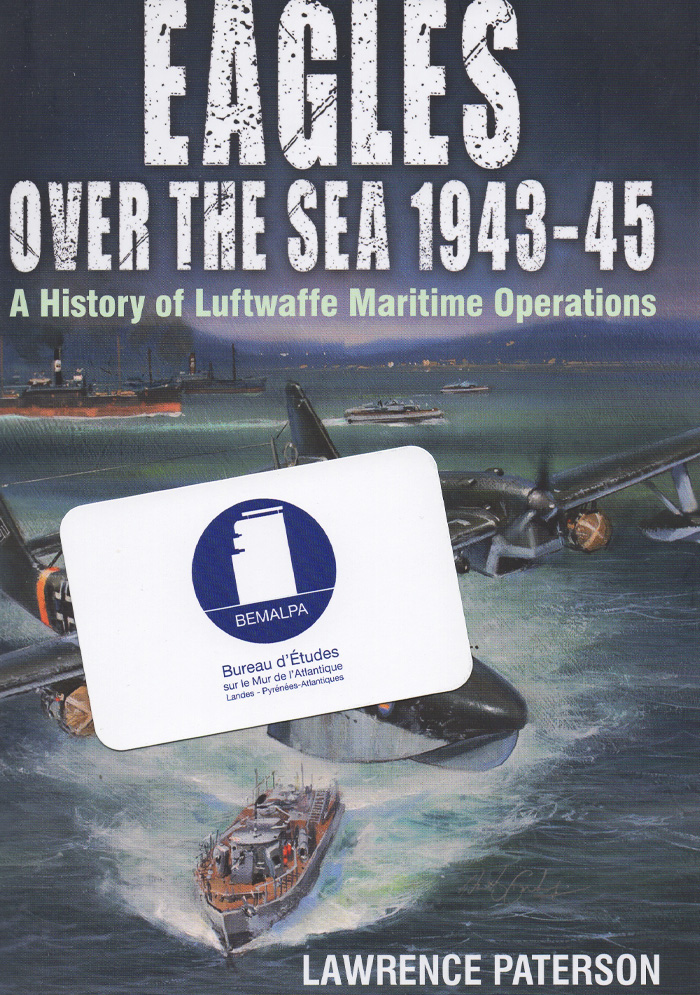
Le livre « Eagles over the sea 1943 – 1945« , par Lawrence Paterson rejoint le centre d’archives militaires du BEMALPA dédié au Mur de l’Atlantique en Nouvelle-Aquitaine.
Ce second volume d’étude des opérations maritimes de la Luftwaffe s’intéresse à la dernière période de la Seconde Guerre mondiale, et complète le premier ouvrage de cette série :
- Eagles over the sea 1935 – 1942
- Eagles over the sea 1943 – 1945
De l’atlantique à la défense du nord de l’Afrique, ce volume consacre un chapitre entier au Golfe de Gascogne et aux missions de la Luftwaffe dans cet espace maritime et complète sur cette période le livre consacré à la Base Aérienne de Mont-de-Marsan Shadow over the Atlantic.
Sommaire
- The Atlantic
- In defense of North Africa
- The Artic and Eastern fronts
- The struggle for Biscay
- Defending Sicily and Italy
- Battles in the Mediterranean and Aegean
- Supporting Atlantic Surface Forces
- Last gasp in the Mediterranean
- The western front
- The final struggle in Norway
- Aircraft introduced into the Luftwaffe maritime forces
Titre : Eagles over the sea 1943 – 1945
Auteurs : Lawrence Paterson
Éditions : Seaforth.
Total pages : 464
ISBN : 9-781526-777652
Résumé de l’éditeur
This is the second volume of Lawrence Paterson’s detailed account of all the Luftwaffe’s naval operations during World War II. The first volume took the story up to 1942, and by the end of that year Hermann G ring’s Reich Air Ministry had subsumed nearly every aspect of Wehrmacht maritime aviation.
Kriegsmarine attempts to develop an independent Fleet Air Arm had been perpetually frustrated, reflecting the chaotic nature of the Third Reich’s internal military and political mechanics. Driven more by vanity than operational prudence, the Luftwaffe had continually thwarted the advancement of maritime aviation, and by 1942 began to reap the whirlwind it had created.
The U-boat war hung precariously in the balance, the lack of well trained and properly equipped aerial reconnaissance suddenly assuming greater importance than ever before. During 1943 the nature of Germany’s war mutated and by its close the Allies were on the offensive in nearly all theatres. This volume resumes the story with Operation Torch in November 1942, when Germany faced an Allied seaborne invasion of North Africa that it was ill-equipped to counter by land, sea or air; and the spectre of even greater invasion armadas loomed on both the southern and western fronts during the months that followed. Facing the Russians, maritime air units were stripped to the bone, those precious few formations available shunted rapidly between military crisis points until barely able to function. The rise of Luftwaffe maritime operations described in the author’s first volume now became, from 1942 onwards, a fall of catastrophic proportions as frequently undertrained crews flew increasingly obsolete aircraft against odds that had become overwhelming.
The Luftwaffe was paying the price for its pre-war lack of cohesive strategic planning, none more so than its beleaguered maritime specialists. The author covers this story across all the theatres of the war and in doing so gives the reader a complete and coherent picture of all the Luftwaffe’s naval operations. Heavily illustrated throughout, this detailed and exciting narrative will be of huge appeal to both naval and aviation historians and enthusiasts.
Ces articles peuvent vous intéresser